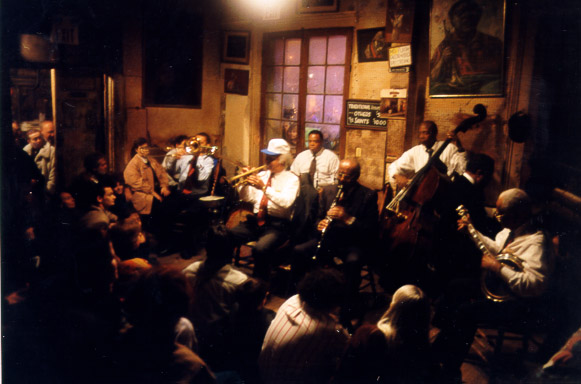
I’ve only been to New Orleans once, when I was 6 or 7 years old. We stopped there for a few days in the middle of one of those interminable family vacations: three weeks in the station wagon, Disney World, the beach, stops to see family and friends. This trip took us from Columbus to Florida, to Alabama, to Texas and then back home.
New Orleans was kind of an afterthought for me, in between the kidly wonderlands of Florida and the promise of a day in Mexico before we headed home. And yet, the best memory I have of that vacation is going to Preservation Hall with my dad.
I remember liking New Orleans a lot more than I thought I would. The cemeteries, with their crypts stacked above the moist bayou soil, were perfect for sparking the darker corners in the imagination of a young boy. Compared with the Scioto River in Columbus, the Mississippi River looked more like an ocean to me. I remember eating in deep courtyards dripping with vines and Spanish moss, which made the tiny area impervious to the clinging heat. I even remember, as I walked with my family down Bourbon Street, a vague sense that New Orleans might me a special kind of fun place to visit when I was older. Not sure what that said about me as a 6-year-old, but it was there.
But mostly I remember Preservation Hall. It’s in the French Quarter, but not in the midst of the craziness of Bourbon Street. I remember it looking and feeling old, even then. There was an iron gate thrown open wide, revealing a crowd inside the room. And at the front of the hall, illuminated by amber lights, were a group of musicians, ancient men, mostly black, all wearing jackets, shirts and ties, as impervious to the heat as the courtyard where I ate my lunch that afternoon.
It was all foreign to me, except the music, which I had been listening to for my entire life. My dad’s record collection was filled with dixieland jazz, just as collection in my grandparents’ house had been. As the band started and the trumpet and clarinet and trombone blended to form the night’s first melody, Dad hoisted me up on his shoulders so I could see — and though I was a thousand miles away from Ohio, I was home.
* * *
I still haven’t been back to New Orleans, and for much of the last seven months I have wondered if I would ever get the chance. I knew that the French Quarter fared pretty well through two hurricanes and the subsequent floods, but the people — who have as much to do with making New Orleans what it is as the European architecture or the spanish moss or the Mississippi River — were no longer there. I wasn’t sure it would ever be the same.
For me, there was one additional concern: Preservation Hall was closed. From what I could gather, the closure was less an issue of flood damage than one of finding people to play; as was the case with many of the city’s musicians, the members of the Preservation Hall Jazz Band lost their homes. Many moved, and haven’t moved back, because there’s nothing to move back to: No homes, no jobs, no bands.
And since September, no Preservation Hall.
Preservation Hall, as an institution, dates back 45 years, but the music it was intended to preserve is nearly a century old. And it’s important, boys and girls — it’s not an exaggeration to say that American Music was born in New Orleans, with the syncopation created and perfected by Jelly Roll Morton and Sidney Bechet and Kid Ory and Louis Armstrong and a host of others whose names we’ll never know. New Orleans music has had a hand in everything — everything — we listen to today. And since September, music in New Orleans has almost died.
* * *
The organizers of the annual New Orleans Jazz and Heritage Festival were determined that that this year’s show would go on as planned. And the Jaffe family saw the presence of extra tourists last weekend and next as a good time to try to get Preservation Hall running again. Last Thursday, the night before this year’s jazz fest got started, there was a private party in honor of Gibson, the guitar builders, who donated instruments to New Orleans musicians who lost them in the floods. And on Friday, preceded by a parade of the house band’s members through the French Quarter, Preservation Hall opened its doors to the public for the first time since last fall.
Of all the stories of rebirth in New Orleans this spring, that’s my favorite. But it’s not done. The hall and the musicians who fill it with music will still struggle once the jazz fest tourists go home. In the past, Preservation Hall had been open seven nights a week; the owners are going to try weekends only for a while, to see if they can make it. And that says nothing of the musicians and their families, not only those in the Preservation Hall Jazz Band but all those players who make New Orleans the most unique musical destination in the country.
I’m sure many of you have already given donations to the Red Cross or through churches or other groups to help the folks in New Orleans. And they need it. But here’s my challenge for you. If you have a decent-sized record store nearby, go take a look at the jazz section. Dial up Amazon and search for “Preservation Hall.” Better still, go directly to the hall’s web page and hit their store. You get to help, but you get something in return. Buy a CD, just one. I own most of the CDs that are available at the hall’s site, and they’re all good. Even if you’re not someone normally inclined to listen to jazz of any kind, I promise — I guarantee — you’ll find something to like on any of those discs.
For about 16 bucks, you get a shot of cool music. You get to give a little help to some musicians who need it and to an institution that’s dedicated to preserving their place in the world. And you get to do something no less than help keep history alive. In my book, that’s a bargain.
 Uncle Crappy
I was driving home early Sunday morning through Bakersfield
Listening to gospel music on the colored radio station
And the preacher said, “You know you always have the
Lord by your side”
And I was so pleased to be informed of this that I ran
Twenty red lights in his honor
Thank you Jesus, thank you lord . . .
Well the preacher kept right on saying that all I had to do was send
Ten dollars to the church of the sacred bleeding heart of Jesus
Located somewhere in Los Angeles, California
And next week they’d say my prayer on the radio
And all my dreams would come true
So I did, the next week, I got a prayer with a girl
Well, you know what kind of eyes she got
LikeLike